
Development of a Specific rsmG Gene Detection Using In House Primer Design of Mycobacterium fortuitum and Modelling Structure of 3D Protein
DOI:
https://doi.org/10.21776/ub.VetBioClinJ.2025.007.01.1Keywords:
Mycobacterium fortuitum, Primer, Protein modelling, rsmGAbstract
Developing specific detection methods for the rsmG gene in Mycobacterium fortuitum is crucial for improving treatment strategies. This study aimed to design and validate an in-house primer detection method for the
rsmG gene in Mycobacterium fortuitum. To detect the rsmG gene in
Mycobacterium fortuitum using DNA fragments based on the effectiveness of the in-house primer. Developing this in-house detection method also highlights the importance of local and in-house primer design for specific gene detection using bioinformatics design and structure. This approach can be applied to other genes and bacteria for further research and treatment. This method is used with
bioinformatics design from the NCBI database based on the OF855_RS30840
and reference sequence NZ_CP107719.1 with gene description of 16S rRNA (guanine (527) N(7) -methyltransferase. The protein model structure template is A0A2U9Q1N61. A using the SWISS-MODEL. The results have 50 - 60% of GC contents from 10 primer pairs with the melting temperature range are 59,33 - 69,46 from NCBI, have forward and reverse. The optimum pairs are the fourth pairs of primers which has optimum self complementarity and relatedness of
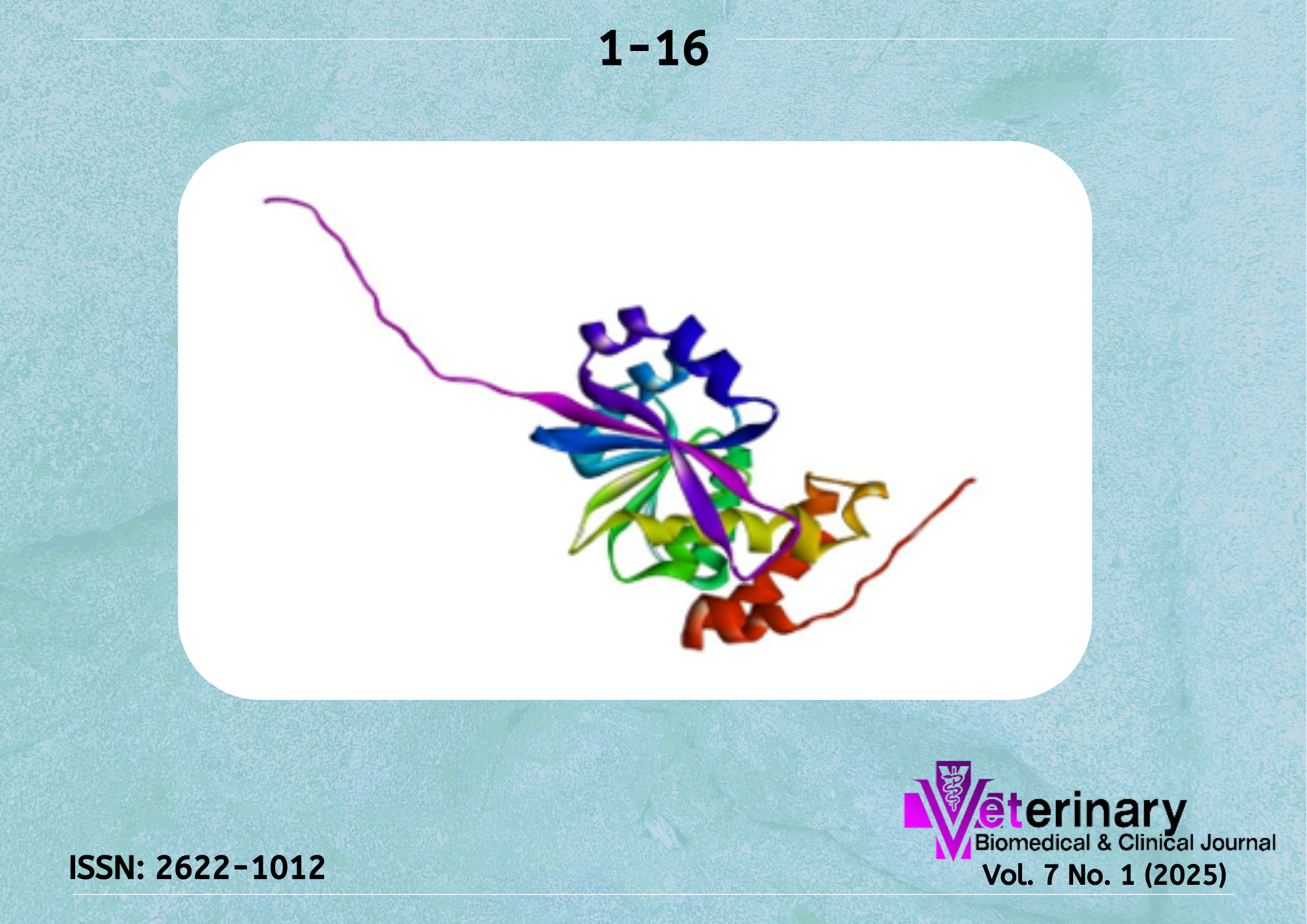
each pair. The results of building model 3D protein were successfully built from
OF855_RS30840. In our conclusion, the primer was obtained and successfully
used to model the 3D structure of the protein encoded by the rsmG gene.
Downloads
References
Alam, M. S., Guan, P., Zhu, Y., Zeng, S., Fang, X., Wang, S., Yusuf, B., Zhang, J., Tian, X., Fang, C., Gao, Y., Khatun, M. S., Liu, Z., Hameed, H.M.A, Tan, Y., Hu, J., Liu, J., Zhang, T. (2023). Comparative Genome Analysis Reveals High-Level Drug Resistance Markers in a Clinical Isolate of Mycobacterium fortuitum subsp. Fortuitum MF GZ001. Front Cell Infect. Microbiol. 12:1056007. doi: 10.3389/fcimb.2022.1056007
Alexov, E., Mehler, E. L., Baker, N., M. Baptista, A., Huang, Y., Milletti, F., Erik Nielsen, J., Farrell, D., Carstensen, T., Olsson, M. H. M., Shen, J. K., Warwicker, J., Williams, S., & Word, J. M. (2011). Progress In The Prediction Of P Ka Values In Proteins. Proteins: Structure, Function, And Bioinformatics, 79(12), 3260–3275. Https://Doi.Org/10.1002/Prot.23189
Biasini M, Bienert S, Waterhouse A, Arnold K, Studer G, Schmidt T, et al. (2015). SWISS MODEL/ Modelling Protein Tertiary and Quatenary Structure Using Evolutionary Information. Nucleic Acid Research .42(15): 252-258. doi: 10.1093/nar/gku340.
Clothier, B.E., Vogeler, I., Magesam. G.N., (2000). The Breakdown of Water Repllency and Solute Transport Through a Hydrophobic Soil. Journal of Hydrology. 231-232: 255-264
Dallakyan, S. and Olson, A. J. (2015). Small Molecule Library Screening by Docking with PyRx. Methods Mol Biol, 1 (1263): 243-250. doi: 10.1007/978-1-4939-2269-7_19
Ferruz, N., Schmidt, S., Hocker, B. (2021). ProteinTools: a toolkit to analyze protein structures. Nucleic Acids Research, 49: 559-566. doi.org/10.1093/nar/gkab375
Garba, L., Mohamad, Yussoff, M.A., Abd Halim,K.B., Ishak, S.N.H., Mohamad Ali, M.S., Oslan, S.N. et al. (2018). Homology Modeling and Docking Studies of a Fatty Acid Desaturase from a Cold Tolerant Pseudomonas sp. AMS 8. PeerJ, (3): 1-21. doi: 10.7717/peerj.4347
Hendling, M., & Barišić, I. (2019). In-silico Design of DNA Oligonucleotides: Challenges and Approaches. Computational and Structural Biotechnology Journal, 17, 1056–1065. https://doi.org/10.1016/j.csbj.2019.07.008PubMed+2
Itoh, Y., Nakashima, Y., Tsukamoto, S., Kurohara, T., Suzuki, M., Sakae, Y., Oda, M., Okamoto, Y., & Suzuki, T. (2019). N+-C-H···O Hydrogen bonds in protein-ligand complexes. Scientific Reports, 9(1). https://doi.org/10.1038/S41598-018-36987-9
Jindam, D., Ravi,L., Krishnan K. (2018) . Construction of Computational Protein Structure Data Base by Homology Modeling for the Aquatic Pathogen Perkinsus Marinus for the Targeted Drug Design and Development. Res J Pharm Technol. 11(6): 2203-2208. doi: 10.5958/0974-360X.2018.00407.9
Joshi, Y.N. dan Gajul, S.G. (2018). In- Silico Homology Modeling of MMP25 Involved in Asthma. IJSRT, 4(9): 202-208. ISSN: 2395-602X
Johansen, M. D., dan Kremer, L. (2020). CFTR Depletion Confers Hypersusceptibility to Mycobacterium fortuitum in a Zebrafish model. Front Cell Infect. Microbiol. 10 (357) : 1- 14. doi: 10.3389/fcimb.2020.00357
Keskin, O., Tuncbag, N., & Gursoy, A. (2016). Predicting protein–protein interactions from the molecular to the proteome level. Protein Engineering, Design & Selection, 29(7), 245–257. https://doi.org/10.1093/protein/gzw020
Kurniawati, S., Mertaniasih, N.M. Ato, M., Tamura, T., Soedarsono, S., Aulanni’am, A., Mori, S., Maeda, Y., Mukai, T. 2020. Cloning and Protein Expression of eccB5 Gene in ESX-5 System from Mycobacterium tuberculosis. BioResearch Open Access. 2020;9(1); 86-93. doi: 10.1089/biores.2019.0019
Kurniawati, S., Soedarsono, S., Aulanni’am, A., Mertaniasih, N. M. 2018. Single Nucleotide Polymorphism of ECCB5 Gene of Mycobacterium tuberculosis complex Isolates From Suspected Pulmonary Tb Patients In Surabaya Indonesia. Afr. J. Infect. 2018;12(2);37-42. doi: 10.21010/ajid.v12i2.6
Keskin, O., Tuncbag, N., & Gursoy, A. (2016). Predicting protein–protein interactions from the molecular to the proteome level. Protein Engineering, Design & Selection, 29(7), 245–257. https://doi.org/10.1093/protein/gzw020ex
Koressaar, T., Medlar, A., Holm, L. (2018). Primer3_masker: integrating masking of template sequence with primer design software. Nucleic Acids Research, 46(18), e103. https://doi.org/10.1093/nar/gky350
Krieger, E., & Vriend, G. (2014). YASARA View—molecular graphics for all devices—from smartphones to workstations. Bioinformatics, 30(20), 2981–2982. https://doi.org/10.1093/bioinformatics/btu426
Lauren, H., Peter K., dan Rossky, J. (2014). A Simple Atomic-Level Hydrophobicity Scale Reveals Protein Interfacial Structure. J. Mol. Biol. 426(2): 484-498.doi.org/10.1016/j.jmb.2013.09.039
Lim AYH, Chotirmall SH, Fok ETK, Verma A, D, Goh SK, Puah SH, Goh DEL, Abisheganaden JA (2018). Profiling Non-tuberculous Mycobacteria in an Asian Setting: Characteristicis and Clinical Outcomes of Hospitalized Patients in Singapore. BMC Pulmonary Medicine. 18 (85): 2-7. doi: 10.1186/s12890-018-0637-1
Mugetti, D., Tomasomi, M., Postorino, P., Esposito, G., Menconi, V., Dondo, A., dan Prearo, M. (2021). Gene Sequencing and Phylogenetic Analysis: Powerful Tools for an Improved Diagnosis of Fish Mycobacteriosis Caused by Mycobacterium fortuitum Group Members. Microorganism, 9 (797): 1-12. doi: 10.3390/microorganisms9040797.
Nishimura, K., Hosaka, T., Tokuyama, S., Okamoto, S., Ochi,K. (2007). Mutations in rsmG Encoding 16S rRNA Methyltransfetase Result in Low Level Streptomycin Resistance and Antibiotic Overproduction in Streptomycin Coelicolor A3(2). Journal of Bacteriology: 3876-3883
Nishiuchi, Y., Iwamoto, T., dan Maruyama, F. (2017). Infwction Sources of Common Nontuberculous Mycobacterial Pathogen, Mycobacterium Avium Complex. Front Med (Lausanne), 7(24): 27. doi: 10.3389/fmed.2017.00027
Olorunfemi, I. E., Ogunrinde, T.A., Fasinmirin, J. T. (2014). Soil Hydrophobicity: An Overview. Journal of Scientific Research & Reports. 3(8): 1003-1037
Pavlik, I., Ulmann, V., and Weston, R. T. (2021). Clinical relevance and environmental prevalence of Mycobacterium fortuitum group members. comment on mugetti et al. gene sequencing and phylogenetic analysis: powerful tools for an improved diagnosis of fish mycobacteriosis caused by mycobacterium fortuitum group members. microorganisms 2021, 9, 797. Microorganisms, 9(11): 2345. doi: 10.3390/microorganisms9112345
Parish, Tanya and Kumar, Anuradha. (2021). Mycobacteria Protocols Fourth Edition. United States: Humana Press.
Prayogi, S., Dhiani, B. A., and Djalil, A. D. (2023). Molecular Docking of Bicycloproline Derivative Synthetic Compounds on Envelope Protein: Anti-SARS-CoV-2 Drug Discovery. Indonesian Journal of Pharmacy and Pharmaceutical Sciences, Vol. 10, No. 1. https://doi.org/10.20473/jfiki.v10i12023.11-21
Saptawati, L., Kusumo, H., and Suryawati, B. (2019). Prevalence of Non-tuberculuos Mycobacteria (NTM) in Surakarta, Indonesia: Higher Than Expected. The 1st International Conference on Health, Technology and Life Sciences, KnE Life Sciences, Page: 132-136. doi: 10.18502/kls.v4i12.4166
Sinha, I., Garde, S., Cramer, S.M. (2023). Comparative Analysis of Protein Surface Hydrophobicity Maps Determined by Sparse Sampling INDUS and Spatial Aggregation Propensity. J Phys Chem B, 127(48): 10304-10314. doi: 10.1021/acs.jpcb.3c04902
Schlossberg, David. (2017). Tuberculosis and Nontuberculous Mycobacterial Infections Seventh Edition. Washington DC: ASM Press.
Sharma, S., Sarkar, S., Paul, S. S., Roy, S., dan Chattopadhyay. (2013). A Small Molecule Chemical Chaperone Optimizes its Unfolded State Contraction and Denatyrant Like Properties. Scientific Report. 3 (3525): 1-9
Thornton, B., & Basu, C. (2015). Real-Time PCR (qPCR) Primer Design Using Free Online Software. Methods in Molecular Biology, 1275, 173–186. https://doi.org/10.1007/978-1-4939-2365-6_16
Untergasser, A., et al. (2012). Primer3—new capabilities and interfaces. Nucleic Acids Research, 40(15), e115. https://doi.org/10.1093/nar/gks596
Velayati, A.A., Farnia, P., Mozafari, M., Malekshahian, D., Seif, S., Rahideh, S., Mirsaedi, M. (2014) . Molecular Epidemiology of Nontuberculose Mycobacteria Isolates from Clinical and Enviromental Sources of a Metropolitan City. Epidemiology of Enviromental and Clinical NTM, Page 1-12
Waterhouse, A., Bertoni, M., Bienert, S., Struder, G., Tauriello, G., Gumienny, R., Heer, F.T., de Beer,T., Rempfer, C., Bordoli, L., Lepore, R., dan Schwede, T. (2018). SWISS-MODEL: Homology Modeling of Protein Structures and Complexes. Nucleic Acid Research, 46 (1): 296-303. doi: 10.1093/nar/gky427.
Wattam, Alice R., James J. Davis, Rida Assaf, Sébastien Boisvert, Thomas Brettin, Christopher Bun, Neal Conrad, Emily M. Dietrich, Terry Disz, Joseph L. Gabbard, Svetlana Gerdes, Christopher S. Henry, Ronald W. Kenyon, Dustin Machi, Chunhong Mao, Eric K. Nordberg, Gary J. Olsen, Daniel E. Murphy-Olson, Robert Olson, Ross Overbeek, Bruce Parrello, Gordon D. Pusch, Maulik Shukla, Veronika Vonstein, Andrew Warren, Fangfang Xia, Hyunseung Yoo, and Rick L. Stevens. (2017). Improvements to PATRIC, the All-Bacterial Bioinformatics Database and Analysis Resource Center. Nucleic Acids Research. 45(1): 535–42. doi: 10.1093/nar/gkw1017
Wijaya, H. and Hasanah, F. (2016). Prediction of the Three-Dimensional Structure of Food Allergen Proteins Using Homology Method with SWISS-MODEL Program. Biopropal Industri, 7(2): 83-94. doi: 10.36974/jbiv7i2.692
Wu TS, Lu CC, Lai HC. (2009). Current Situations on Identification of Nontuberculous Mycobacteria. J. Biomed. Lab. Sci, 21(1): 1-5
Ye, J., Coulouris, G., Zaretskaya, I., et al. (2012). Primer-BLAST: a tool to design target-specific primers for polymerase chain reaction. Bioinformatics, 28(20), 2537–2539. https://doi.org/10.1093/bioinformatics/bts640
Zhang, Y., Skolnick, J., & Kihara, D. (2017). Modeling protein quaternary structure of homo- and hetero-oligomers beyond binary interactions by homology. Scientific Reports, 7, 10480. https://doi.org/10.1038/s41598-017-09654-8
Downloads
Published
Issue
Section
License
Copyright (c) 2025 Roro Titah Pinasti, Siti Kurniawati , Najma Ramadhani , Averoes Gibraltar Makta , Diaz Ayu Savitry

This work is licensed under a Creative Commons Attribution-NonCommercial 4.0 International License.